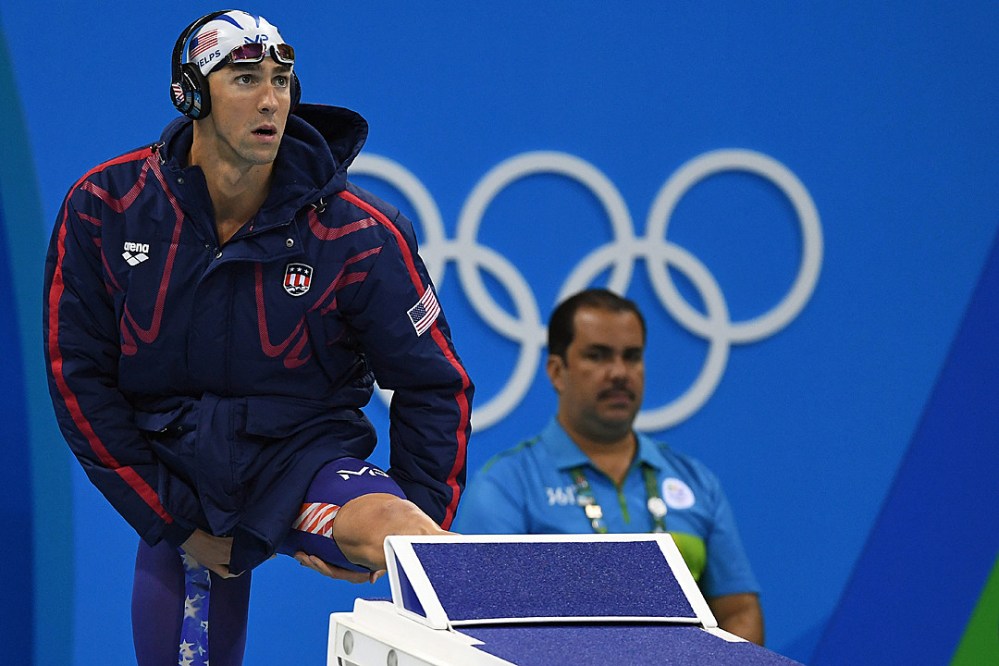
Before the start of a race, Michael Phelps can be seen entering the venue, sporting a pair of headphones until the very last few minutes before he steps onto the starting block. This has been a common sight for several years now. When asked why he always listens to music before a race he says, “It helps me to relax and get into my own little world”[1]. This is only one component of what is an extensive routine followed by the most decorated Olympian of all time. Following a routine seems to reduce distraction and provides him with a sense of control leading up to the race, which is the essence of any effective pre-performance routine.
A pre-performance routine is defined as “a sequence of task-relevant thoughts and actions which an athlete engages in systematically prior to his or her performance of a specific sport skill”[2] (p. 177). Simply put, it involves the development and practice of certain skills to optimise performance, preparing yourself to be “in the zone”, or in an ideal mental state, before executing the necessary skill. Athletes devote most of their time preparing for sport physically. Mental preparation is just as important but is often neglected. Understanding the importance of pre-performance routines, as well as the role of each of the steps involved, helps develop and use them effectively during competitions [3]. So, if you think a pre-performance routine could benefit you as a sportsperson, as a coach hoping to educate your athletes, or just as an individual looking to have the upper hand in any performance aspect of your life, this post should hopefully get you started with developing your own routine.
The Benefits of Pre-Performance Routines
Using a pre-performance routine helps set the tone for everything that is to follow, and prevents rushing a shot by providing a structured method of preparing for it. In elite sport, the skills required for effective performance are usually already learned. However, predictability means that less conscious effort is required for the task. This is called the “autonomous phase of motor learning”. The drawback with requiring minimal mental effort is that in a competitive environment, there may be several distractions, which could occupy the mind. Therefore, pre-performance routines are essential to remain mentally focused and prevent disruptions, both from the surroundings and one’s own negative thoughts, to ensure that the desired skill is executed as planned [4].
Using a routine that is purely behavioural, involving only actions, could be ineffective in the long run as it runs the risk of becoming automatic over time, much like the skill itself. Developing cognitive-behavioural strategies, such as pre-performance routines, ensures that the individual is mentally engaged, even while performing a skill that has become automatic [5].
Additionally, pre-performance routines can improve confidence by preventing overthinking and overanalysing skills that are already well learnt. They also improve one’s ability to focus on task-relevant cues and select the most ideal skill to execute in that situation [6]. Having a pre-performance routine could even reduce the chances of “choking” under pressure [7].
Routine Vs Superstition
At this point, it is crucial to make a distinction between pre-performance routines and superstitions. Behaviours are considered to be superstitious when people believe unrelated events or behaviours to be linked with enhanced performance when no such connection with the skill actually exists. Often, they are very rigid with respect to order and timing. Pre-performance routines have a clear purpose, related to the necessary skill or task to be executed, whereas superstitious behaviours seem unrelated to the actual task. Superstitious behaviours are also likely to be more complex and longer in duration when compared to routines.
For example, a football player may insist that for his team to win, he must wear his right shoe before the left shoe and kiss the wall of the changing room just before entering the field. This behaviour is unrelated to the role he must fulfil on the field. Whereas, a golfer who keeps his eyes focused on where he wants to hit, takes two practice swings before stepping up to the tee, and then takes his shot, demonstrates behaviour that is clearly related to the task and helps him execute the skill accurately. The former is an example of superstitious behaviour while the latter is an example of a routine.
Superstitions are not necessarily bad when they serve an anxiety-reducing function, but they could provide a false sense of control which becomes problematic when they lead people to do things that will not help with task execution. Sometimes, this also prevents people from taking measures that could actually improve performance [8].
The Five-Step Approach (5-SA)
Singer proposed a clear Five-Step Approach (5-SA) to learning and developing self-paced athletic skills [9]. These steps can easily be applied to develop pre-performance routines for “closed-skills” in sports. These are skills that are initiated by the individual giving them the time to prepare and choose when they want to act. Some examples of such skills include free throws in basketball, a serve in tennis, a penalty shootout in football, a golf swing or even bowling in cricket. This is in contrast to externally-paced “open-skills” which are generally reactive and time-limited, such as returning the ball in tennis or a pass in football.
The 5-SA can be applied quite easily to develop effective pre-performance routines and can be adopted across sports and skill levels to enhance performance. Pre-performance routines can be used to learn the desired motor skills and perform at an optimal level consistently. The 5-SA describes a sequence of five stages involved in developing effective pre-performance routines.
The five steps are:
- Readying
- Imaging
- Focusing Attention
- Executing
- Evaluating
Readying
“I’ve learned over the years that if you start thinking about the race, it stresses you out a little bit. I just try to relax.” – Usain Bolt [10]
The optimal arousal level of a boxer and a golfer trying to make a putt will be significantly different, with the boxer requiring higher levels of arousal, and the golfer requiring composure, patience and precision. Therefore, the first step would be for the athlete to identify what an appropriate level of arousal would be for the specific skill to be executed, whether they need to be “psyched up” or calm and composed [9]. This awareness helps identify one’s “individual zone of optimal functioning”, as too much or too little arousal could lead to suboptimal performance [11]. Readying also involves developing positive beliefs in one’s ability to execute the necessary task.
Activating techniques, including boosting heart rate by listening to upbeat music and taking quick shallow breaths can help increase arousal levels. Engaging in deactivating techniques, such as listening to relaxing sounds and meditating can be used to reduce arousal levels. Self-talk can help maintain appropriate levels of arousal and develop a sense of belief in one’s own ability [12]. There are two main types of self-talk – motivational and instructional. Motivational self-talk is used to create a positive mood, while instructional self-talk focuses on the technicalities involved in the skill [13]. Of the two, motivational self-talk, including statements such as “Come on, you’ve got this!” or “Deep breath. Focus.”, has more arousal function and can be effectively used to energise oneself, to control nerves or to balance the two conflicting emotions [12].
Imaging
“I visualise what the guy I’m guarding is going to do, what his tendencies are, and how am I gonna play against that.” – Michael Jordan [14](p. 79)
The second step involves creating a mental picture of the act itself and imagining every intricate detail, from the beginning until the successful completion of the behaviour. Visualising the successful behaviour from start to finish is an important precursor to actually executing the behaviour successfully [9]. Negative visualisations can be detrimental to performance and therefore, it is necessary to reduce the incidence of these [15]. Negative imagery could arise due to negative past experiences or from coaches giving instructions on what not to do, rather than what is actually to be done [16].
There are two kinds of imagery that can be used – internal and external imagery [17]. Internal imagery involves visualising yourself performing the desired behaviour from your own perspective, while external imagery involves viewing the event or behaviour from a third-person’s perspective. Internal imagery has been found to be more beneficial than external, as visualising oneself executing the skill activates certain brain structures, as if the individual was actually performing the behaviour [18]. The more engaged an athlete is with the visualisation, focusing on the nuances of the behaviour and the sensations involved, the more effective it will be.
Focusing Attention
“I just took it ball by ball, trying to give every delivery 100% concentration.” – Michael Atherton [19] (p. 25)
The third step requires improving concentration towards task-relevant stimuli while reducing the influence of distracting, task-irrelevant stimuli [9]. Distractions compete for the limited attentional resources available. This is especially pertinent at an elite level, where there are several distractions from the environment, expectations from others, as well as pressures from within. Therefore, it would be beneficial to focus attention on important aspects of the event or behaviour, limiting the available space for distractions to occupy the mind. During a match, short cue words that serve as reminders of the skill, such as “straight”, “control” or “clean strike”, can aid concentration and reduce anxiety [7].
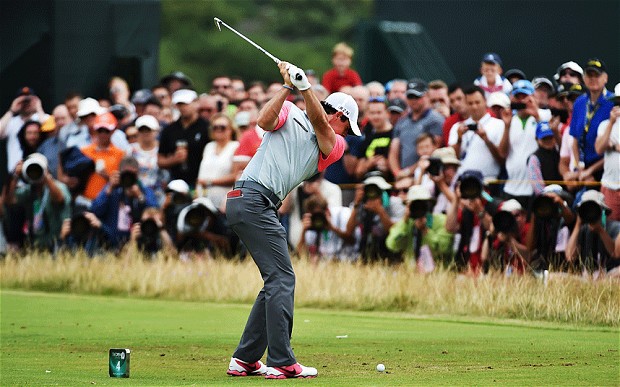
It may be beneficial to develop a strategy to focus in advance, by identifying aspects of the environment that require attention during the given situation and using specific cues [2]. Attention can be effectively developed through simulation training [20]. This allows for distractions to be identified before a big match, during practice sessions, in order to reduce novelty of competitive situations. Simulation training involves practising in conditions similar to the actual match conditions. This can be achieved by training in venues or locations similar to the match venue, training in front of loud crowds, and even practising in uniform or at the same time as the actual match [21]. It is also beneficial to anticipate, identify and simulate circumstances that could arise during the match if things do not go according to plan. Having prepared for these situations before, players will be focused and confident in their ability to face similar adverse circumstances, should they arise.
Executing
“It’s about discipline. It’s about following instructions. It’s about the execution of the plan. That’s what sport is.” – Ian Millar, Canadian Olympic silver medalist
The fourth step is self-explanatory and involves actually carrying out the desired behaviour, hopefully as visualised in the earlier steps [9]. Sometimes, there might be a need to modify or adjust the behaviour to match the demands of the environment. This requires flexibility to choose the most appropriate behaviour based on the situation and execute it accurately.
Evaluating
“I think self-awareness is probably the most important thing towards being a champion.” – Billie Jean King
The fifth, and final, step requires reflecting upon and analysing the behaviour that was ultimately executed, in order to get some immediate feedback about how effectively the skill was implemented in practice [9]. It is necessary to evaluate the behaviour, in order to understand what worked and what did not, where you stand, and to feed back into the earlier steps regarding what needs to be improved going forward. Sometimes, depending on the nature of the sport it may not be possible to immediately evaluate one’s own behaviour. For example, after serving in volleyball, the individual needs to be prepared to face the return from the opposition and cannot afford to be mentally preoccupied with evaluating the effectiveness of the serve. Nonetheless, one should eventually reflect upon their performance to develop self-awareness.
Consistency is Key
While using the 5-SA with basketball players, the readying stage was found to be the most important for mental preparation [22]. As preparation time increased, the success rate improved as well. The readying stage probably lays the foundation for the rest of the pre-performance routine. Therefore, it is crucial to pay enough attention to each step in the process and practise the routine regularly, both during training sessions, and matches.
Research indicates that superior performers adhere to their routines consistently [23] and if the routine is rushed, the behaviour may be poorly executed and the probability of committing an error is high. However, tasks that were more difficult may require more preparation time for successful execution, and easier skills may be accurately performed with less preparation time [24].
Although a pre-performance routine needs to be consistently followed, both during training sessions, while developing or perfecting a skill, as well as during matches, caution should be taken to ensure that the routine itself isn’t too rigid. It should allow for some flexibility, as an inflexible routine, when broken, could lead to increased anxiety, potentially setting up the rest of the skill execution for failure [25].
Make It Your Own
The 5-SA is to be taken as a generalised framework to follow and help an athlete develop their own pre-performance routine. The key advantage of having such a broad framework is that it is flexible and provides scope for personalisation. The fifth “evaluating” step in the 5-SA takes into consideration the necessity for each individual to reflect upon and make changes to the routine based on what worked and what did not [9]. Evidence suggests that pre-performance routines, especially the psychological skills employed within it, vary depending on each individual’s personality, coping resources, and evaluation of the situation [3].
When you develop your own pre-performance routine, take into consideration the specific nature and context of your sport. Further, you should tailor the routine based on your skill level and preferences in order to get the most out of your potential [5]. Having followed these steps, you should be better equipped to conquer the game, even before you take your first shot.
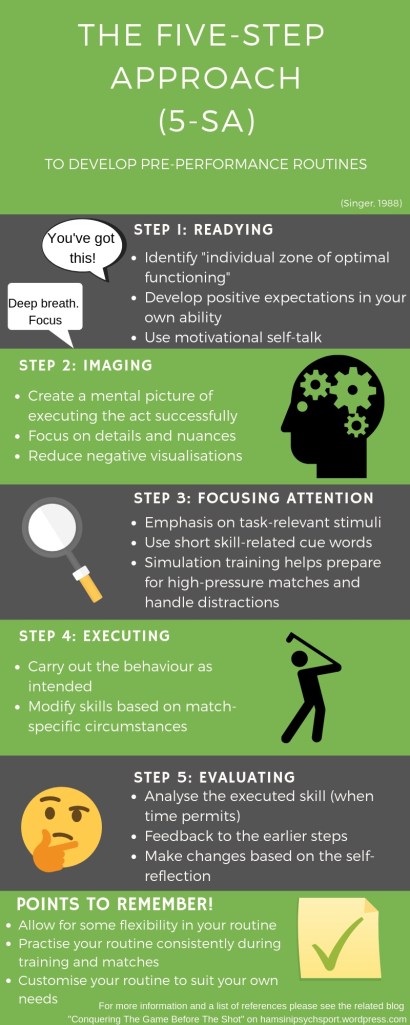
The following is a summary infographic of the content of this blog:
If you have any questions regarding the content of this blog, please email h.sivaramakrishnan-18@student.lboro.ac.uk
References
- Honeyball, L. (2005, July 3). On being…Michael Phelps. The Guardian. Retrieved from http://www.theguardian.com
- Moran, A.P. (1996). The psychology of concentration in sports performers: A cognitive analysis. Hove: Psychology Press.
- Cotterill, S. T., Sanders, R., & Collins, D. (2010). Developing effective pre-performance routines in golf: Why don’t we ask the golfer?. Journal of Applied Sport Psychology, 22(1), 51-64.
- Jackson, R. C. (2001). The preshot routine: A prerequisite for successful performance? In P. R. Thomas (Ed.), Optimising performance in golf (pp. 279-288). Brisbane, Australia: Australian Academic Press.
- Cohn, P. J. (1990). Preperformance routines in sport: Theoretical support and practical applications. The Sport Psychologist, 4, 301-312.
- Boutcher, S.H. (1992). Attention and athletic performance: An integrated approach. In T.S. Horn (Ed.), Advances in sport psychology (pp. 251-266). Champaign, IL: Human Kinetics.
- Mesagno, C., & Mullane-Grant, T. (2010). A comparison of different pre-performance routines as possible choking interventions. Journal of Applied Sport Psychology, 22(3), 343-360.
- Colino, S. (2016, October 26). How Superstitions Are Affecting Your Behavior. Retrieved from https://health.usnews.com/wellness/mind/articles/2016-10-26/how-superstitions-are-affecting-your-behavior
- Singer, R. N. (1988). Strategies and metastrategies in learning and performing self-paced athletic skills. The Sport Psychologist, 2(1), 49-68.
- Howard, D. (2011, November 30). Bolt: “I want to do wild things”. ESPN. Retrieved from http://www.espn.com
- Hanin, Y. L. (1980). A study of anxiety in sports. In W. F. Straub (Ed.), Sport psychology: An analysis of athlete behavior (pp. 236–249). Ithaca, NY: Mouvement.
- Hardy, J., Gammage, K., & Hall, C. (2001). A descriptive study of athlete self-talk. The Sport Psychologist, 15(3), 306-318.
- Hatzigeorgiadis, A., Zourbanos, N., Galanis, E., & Theodorakis, Y. (2011). Self-talk and sports performance: A meta-analysis. Perspectives on Psychological Science, 6(4), 348-356.
- Stauth, C. (1992). The golden boys: The unauthorized inside look at the US Olympic basketball team. New York: Pocket Books.
- Bartlett, K. (1994). For many athletes, fear is the opponent to beat. Providence Journal, 13 Feb, 9-10.
- Rodgers, W. M., Hall, C., & Buckolz, E. (1991). The effect of an imagery programme on imagery ability, imagery use and figure skating performance. Journal of Applied Sport Psychology, 3, 109-125.
- Epstein, M. L. (1980). The relationship of mental imagery and mental rehearsal to performance of a motor task. Journal of Sport Psychology, 2(3), 211-220.
- Holmes, P. S., & Collins, D. J. (2001). The PETTLEP approach to motor imagery: A functional equivalence model for sport psychologists. Journal of applied sport psychology, 13(1), 60-83.
- They all agree: It was one of the great test innings. (1995, December 5). The Guardian, p. 25.
- Orlick, T., & Partington, J. (1988). Mental links to excellence. The sport psychologist, 2(2), 105-130.
- Vealey, R. S. & Greenleaf, C. A. (2006). Seeing is believing: Understanding and using imagery in sport. In J. M. Williams (Ed.), Applied sport psychology: Personal growth to peak performance (pp.306-348). New York: McGraw-Hill.
- Lidor, R., & Tenenbaum, G. (1993). Applying learning strategy to a basketball shooting skill: A case study report. In R. Lidor, D. Ben-Sira, & Z. Artzi (Eds.), Physical activity in the lifecycle: The 1993 FIEP World Congress proceedings. Netanya, Israel.
- Douglas, K., & Fox, K.R. (2002). Performance and practise of elite women European tour golfers during pressure and non-pressure putting simulation. In E. Thain (Ed.), Science and golf IV (pp. 246-256). London: Routledge.
- Jackson, R. C. (2003). Pre-performance routine consistency: temporal analysis of goal kicking in the Rugby Union World Cup. Journal of Sports Sciences, 21(10), 803-814.
- Gallucci, N. T. (2014). Sport psychology: Performance enhancement, performance inhibition, individuals, and teams. New York: Psychology Press, Taylor & Francis Group.

 Performance Psychology and Sport
This is such a well written article … I could relate this to a lot of things that my coach told me when I played professional tennis.
The superstition factor somehow creeps in I guess .. hehehe .
But overall I think the 5 step approach is brilliant and will help a lot of sportsmen & women with their psychological preparation and performance.
LikeLike
I’m glad to hear that you were able to relate to it!
LikeLike
I think it’s a pretty precise article in general and it’s a process that is actually relevant to all platform of competition and will definitely have a positive outcome.
LikeLike
A very interesting read. Might be a pre- exam routine like this might help students get over the fear of exams too.
LikeLike
Very nice! Very helpful for young sport psychologists.
LikeLike
I’m sure routines help, and Aniketh too would use headphones whilst waiting for the sailing races to start. Like the distinction between superstition and routine, which is often confused. As a hockey dad wish you’d written this a bit earlier.
LikeLike
I think it’s a pretty precise article in general and it’s a process that is actually relevant to all platform of competition and will definitely have a positive outcome.
LikeLike
I think what you say is true of other “high performance” situations in life as well – not just sport. SO be in a big presentation or speech at work I do believe the 5SA process would work well – personally a big believer, from experience, in the power of positive internal visualization.
LikeLike
Review on the article by Hamsini
This is Shankar Krishnaswamy. Happen to read your article on developing an effective pre-performance routine for a sportsperson & here is my review on this article.
At the outset, ‘am being a cricketer myself in school days and having played districts and also league matches in India and UK, I could relate the pre-performance routines and the 5- step approach (5-S A). This article opens up my memories and gave a better insight into the benefits of following a routine before a sports performance. I myself would have done some of these without knowing the scientific benefits of it. I also understood how a sportsperson needs to prepare oneself both physically and mentally before a game.
I always wondered about how few sports people show certain kind of behavior, sporting spirit before or during their game. Now I can understand and differentiate things which are routine and superstitions.
The 5-SA explained in this article will really help the existing and upcoming sportsperson to improve themselves and achieve better their sports.
The 5-SA explains how different levels of arousal is required for different sports, for achieving optimal performance level. It explains how motivational and instructional self-talk help oneself in achieving the optimal arousal level.
It touches on the point on how visualizing intricate details of the performance help in successful execution of the activity. Articles gives a perspective on how internal visualization is more beneficial in activating certain brain structures. It explains how focusing on the important aspects of the event or the behavior help reducing the distraction and take oneself towards success.
I could relate to cricket as to how conditions such as climate and environment effect the performance of the players when they play in home ground and abroad. The success rate depends on the ability to execute in an appropriate way to the situations and conditions.
A thorough evaluation after performance will always help to identify the points which helped in achieving the desired result and also identifying the mistakes so that they can be course corrected for future performances.
Some of the points mentioned in the 5-SA may also be used in other skill based disciplines like music. My son is learning music and could use points like focus on details and nuances, focus attention.
Wonderful article Hamsini! Keep up the good work and wish you present more articles and case studies like these.
Regards,
Shankar K
LikeLike
A wonderful article. Important to explain why PPRs work and to differentiate between routines and superstition. I find athletes confuse these and often make their PPRs rigid, which at times makes them more anxious trying to get everything to go just right. And a nice cook-book five-step approach. Good to see Bob Singer’s work carrying on!
LikeLike